The Science Behind
Waterfall
Our methodology isn't intuition — it's built on decades of peer-reviewed research in cognitive science, neuroscience, and behavioral psychology. Here's the evidence.
Humans Are Built for Stories
Long before cave paintings, before written language, before books — humans told stories. It's not a cultural habit. It's how our species is wired.

Stories Are Evolutionary
In a study of the Agta hunter-gatherers, skilled storytellers were preferred social partners and had more surviving offspring. Stories conveyed cooperation and survival behaviors essential to the group.
Smith et al., 2017 — Nature Communications81% of Firelight Talk Is Stories
Among the Ju/'hoan Bushmen, daytime talk was only 6% stories. At night around the fire, it jumped to 81%. Nighttime stories healed social rifts, conveyed cultural knowledge, and helped people understand their world.
Wiessner, 2014 — PNAS50,000+ Years of Oral Tradition
Cave paintings depicting figurative storytelling date to at least 51,200 years ago. Writing was invented only 5,000 years ago. For 90%+ of human history, all knowledge transfer happened through spoken stories.
Sugiyama, 2001 — Evolution and Human Behavior"Narrative is a human adaptation for information acquisition — enabling individuals to safely acquire survival-critical information by substituting verbal representations for potentially costly firsthand experience."
— Michelle Scalise Sugiyama, Evolution and Human Behavior, 2001
Your Brain on Stories
Stories don't just entertain — they physically change your brain chemistry, sync neural patterns between people, and activate regions that facts alone cannot reach.

Stories Release Oxytocin
Character-driven stories with a dramatic arc cause the brain to release cortisol (focuses attention) and oxytocin (promotes empathy). This directly motivated prosocial behavior — people gave more money to strangers after hearing a story.
Zak, 2015 — Cerebrum (Dana Foundation)Brains Sync During Stories
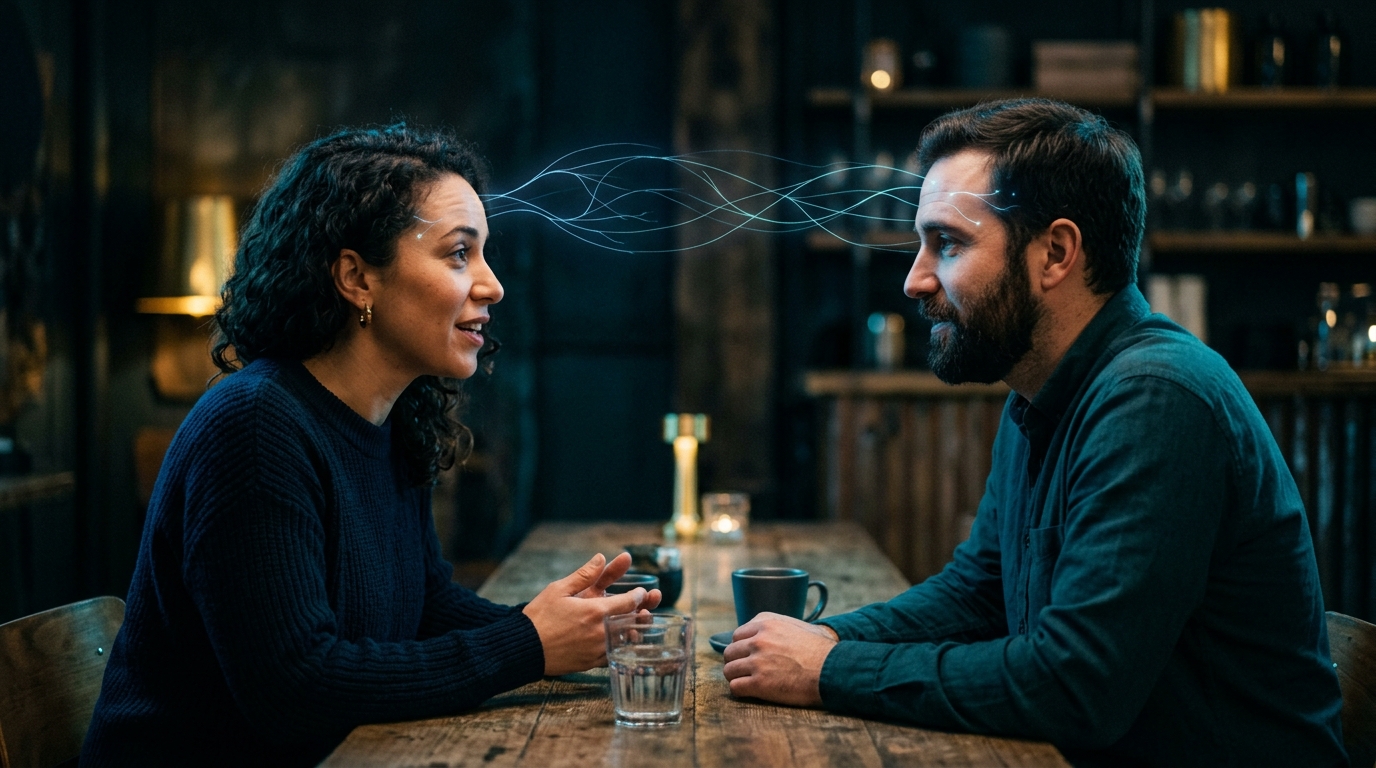
fMRI scans show that during storytelling, the speaker's brain activity becomes spatially and temporally coupled with the listener's. The greater the coupling, the greater the comprehension. The speaker literally guides the listener through a sequence of brain states.
Stephens, Silbert & Hasson, 2010 — PNASStories Activate the Whole Brain
Reading stories activates motor, visual, and spatial brain regions — the same areas engaged when actually performing those activities. Facts activate language centers only. Stories create full-body neural simulations.
Speer et al., 2009 — Psychological ScienceStories Beat Facts. Every Time.
The evidence is overwhelming: information encoded as narrative is understood faster, remembered longer, and recalled more accurately than any other format.
Subjects who wove word lists into stories recalled 93% vs. 13% for rote learning — a seven-fold improvement.
Bower & Clark, 1969 — Psychonomic Science
A meta-analysis of 33,000+ participants found stories were read twice as fast yet remembered twice as well as expository text.
Mar et al., 2021 — Psychonomic Bulletin & Review
People who read more fiction scored higher on empathy and theory of mind — fiction functions as a flight simulator for social life.
Mar & Oatley, 2008 — Perspectives on Psychological Science
The Science Behind Our Questions
Every question in our framework is designed using peer-reviewed techniques from cognitive science, behavioral psychology, and neuroscience. Here's why each technique works.

Episodic Memory Activation
Solomon's Paradox
Temporal Distancing
Confession Framing
Default Mode Network
Embodied Cognition
The Why Drill (Elaborative Interrogation)
Storytelling Heals
Sharing stories isn't just good for data collection — it's clinically proven to benefit seniors' mental health, cognitive function, and sense of purpose.

Reduces Depression
A meta-analysis of 20 controlled studies found reminiscence and life review therapy had a clinically significant effect on late-life depression (d = 0.84).
Bohlmeijer, Smit & Cuijpers, 2003 — Int. J. Geriatric PsychiatryImproves Cognition
Reminiscence therapy showed moderate effects on depressive symptoms and measurable improvements in cognitive function for elderly people with dementia.
Huang et al., 2015 — J. American Medical Directors AssociationBuilds Purpose & Connection
Structured story-sharing increases well-being, fosters friendships, enhances self-esteem, and helps seniors understand and appreciate their life stories.
Birren & Cochran, 2001 — Johns Hopkins University PressLife review therapy was pioneered by Robert Butler in 1963, who proposed that reviewing one's past plays an adaptive role in coming to terms with life's finitude. His foundational paper inspired hundreds of scientific studies and the creation of the International Institute for Reminiscence and Life Review.

Built on science.
Powered by wisdom.
Our methodology produces training data that no web scrape, book corpus, or synthetic generation can replicate. The science ensures we capture what matters.