Your students interview the people who raised the world.
A school project where every student sits down with a grandparent or neighbour, asks your questions, and really listens. Waterfall records the interview, sorts it by question, and gives you what you need to assess it.
$99 per class per term. Ask about a free pilot term.
For students
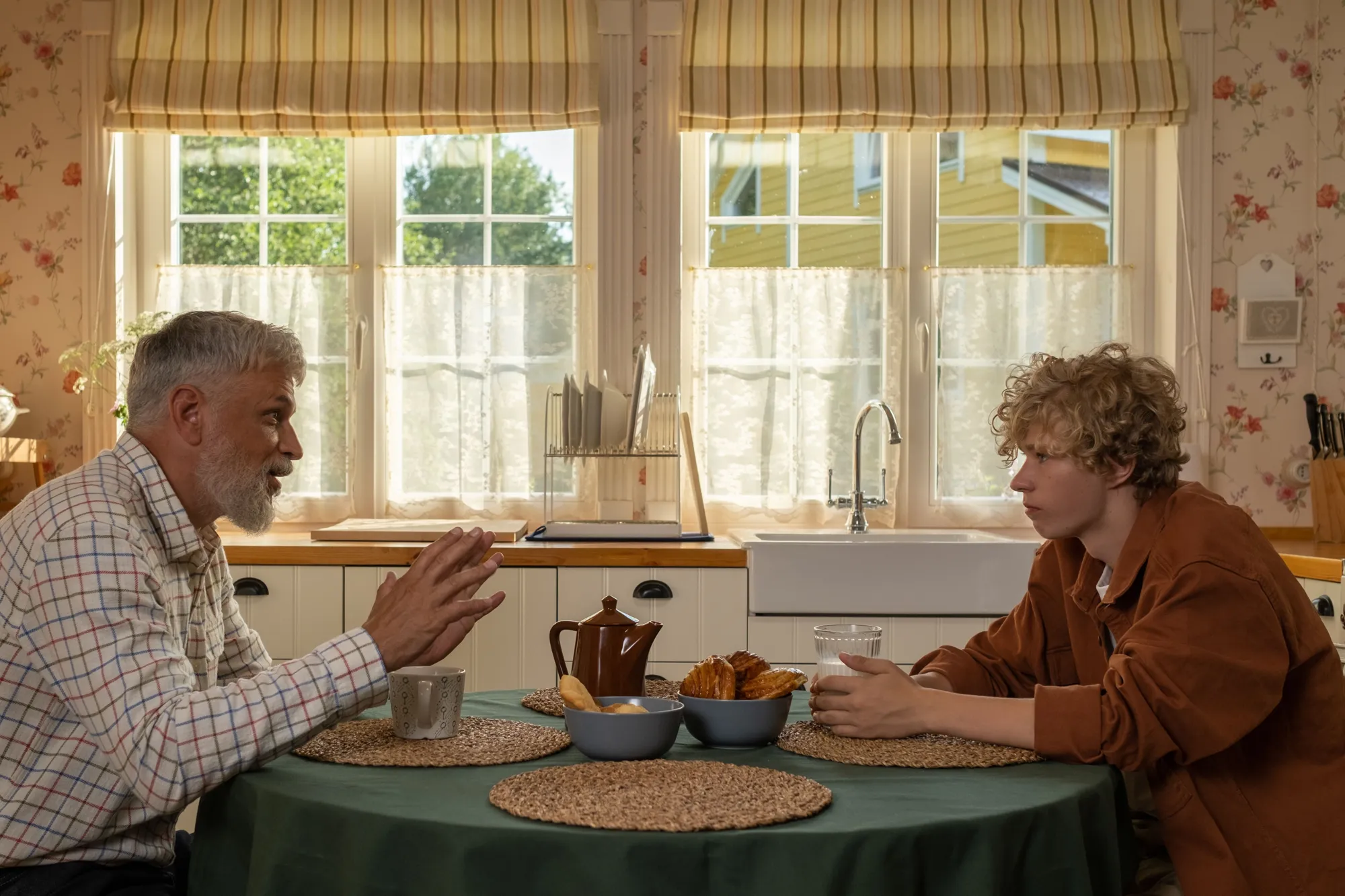
They learn to ask a good question, wait for the answer, and follow up. Most of them also hear a story they never knew.
For teachers
You write the questions and the rubric. Waterfall handles the recording, the transcript and the sorting, so your time goes into listening and feedback.
For storytellers
Someone young asks about their life and listens to the answer. They keep the interview, free, in their own Waterfall book.
How it works
Create a class
Write your own questions or pick from our library. Add your rubric and a time limit.
Students join with a code
They type the class code and their first name. No email, no password.
They interview in person
On a phone, Chromebook or iPad, sitting with a grandparent or neighbour. One question on the screen at a time.
Waterfall sorts it out
It recognises who is speaking from the introductions, writes the transcript, and organises the interview by question.
You listen, score and reply
Score with your rubric. AI drafts a first pass with quotes from the interview, you approve or change it, then release feedback.
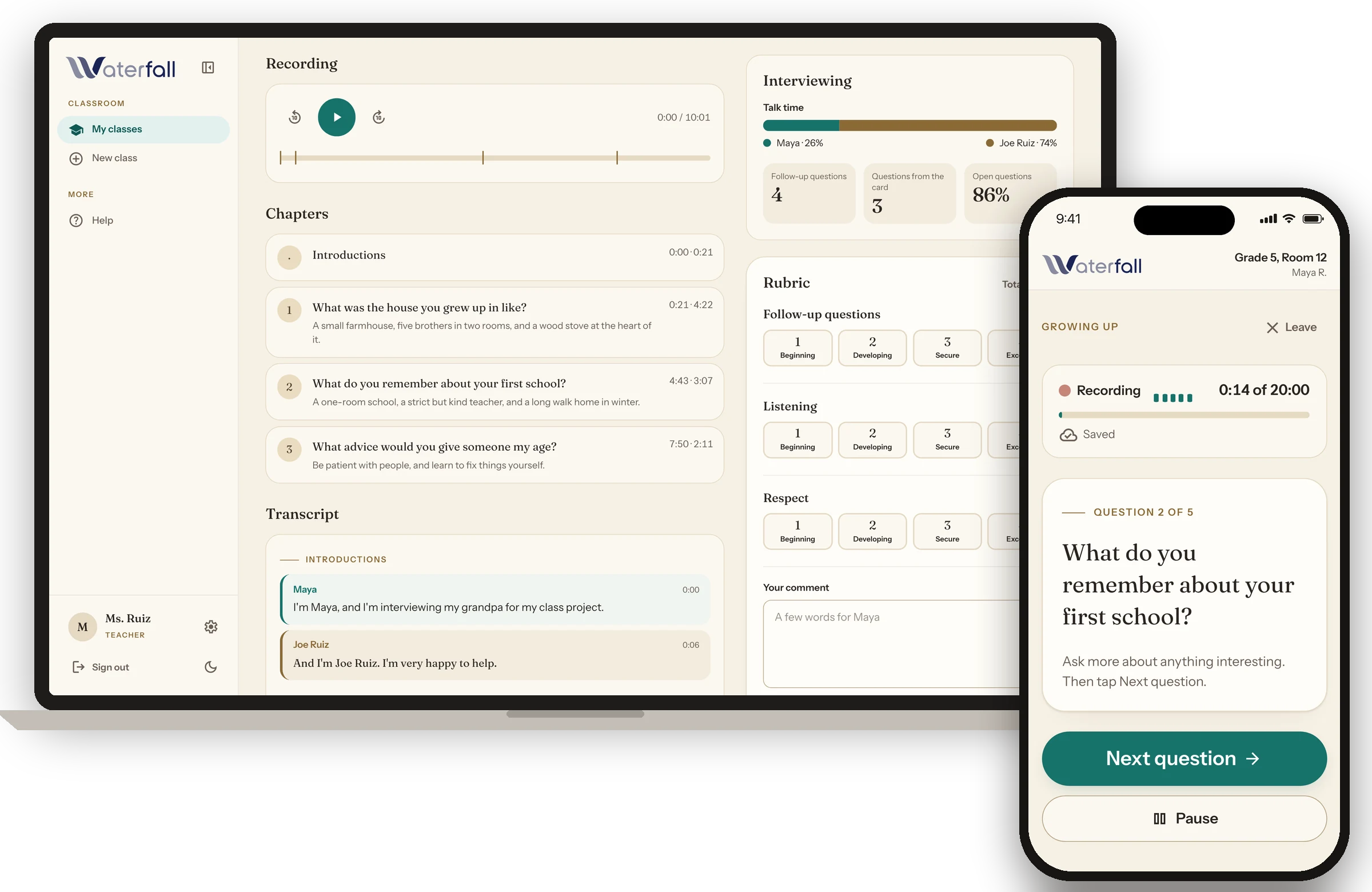
Every interview, organised by question.
Each question is its own chapter, with the student and the storyteller in different colours. Talk time and follow-up questions show how well the student listened, and your rubric sits right beside the recording.
The storyteller keeps a free copy.
The storyteller can leave a phone number or email. When the interview is ready, they get a private link to listen and read, and one tap adds it to their own Waterfall book. It is free, and it is theirs to keep.
Joe's Waterfall book
Growing up on the farm
“Five boys in two rooms, and a wood stove that was the heart of everything.”
Interviewed by his granddaughter Maya, Grade 5
Safe for students of every age, including under 13.
School consent, plus a permission slip
The school gives consent for an educational purpose. A printable permission slip for families comes in 10 languages.
First name only
Students join with a first name and last initial. No email, phone number, photo or birthday.
You approve every student
A code alone does not get anyone into your class. You approve each student who joins, and you can change the code at any time.
Never used to train AI
Classroom interviews are never used to train AI models, ours or anyone else's.
Canadian recordings stay in Canada
For Canadian classes, recordings and transcripts are stored in Canada.
Deleted after the term
Recordings and transcripts are deleted 60 days after the term ends. We remind you to export everything first.
No ads, no social sharing
Students never see ads, prices or anything public. There is nothing to post, like or follow.
Good for students, and for the people they interview.
Conversations across generations and telling one's life story are both well studied. Here is some of what researchers have found.
For students
A meta-analysis of 63 studies with 6,124 participants found that learning about ageing and spending time with older people both reduce ageism, improving attitudes and knowledge. Combining the two worked best for attitudes, and effects were stronger for teenagers and young adults.
In a randomised experiment with 90 teenage girls and 90 women aged 70 to 74, working together across generations, in a setting that invited the older woman to pass on what she knew, led to more prosocial behaviour in the teenagers.
In a small Australian pilot, high school students interviewed older people every week for a term. Afterwards they described everyday life in the past with specific detail from their partners' stories, while students still waiting their turn spoke in broad terms.
Children and teenagers who knew more about their family's history also had higher self-esteem, a stronger sense of control over their lives, and lower anxiety.
For storytellers
A meta-analysis of 128 controlled studies found that reminiscence, remembering and sharing one's past, eased depressive symptoms and strengthened a sense of integrity in later life, with smaller gains in purpose in life and wellbeing.
A review of fifty years of research describes how telling the story of your life helps people form bonds with others, cope with big life events, and find meaning in their lives.
In a 10-year US study of adults aged 60 to 75, those who felt they were giving something to others and to younger generations had lower odds of new disability or of dying, even after accounting for their health at the start.
A systematic review of 24 US studies linked intergenerational programmes with better physical and psychosocial health for older adults, including less depression, along with stronger social relationships and better quality of life.
These studies looked at programmes and conversations like these, not at Waterfall itself.
All our research and referencesOne simple price per class.
Everything a class needs for a term: up to 35 students and 2,000 interview minutes.
Teachers can pay by card, or the school can pay an invoice.
Ask about a free pilot termBring the generations into your classroom.
Set up a class in a few minutes. We review every new class before students can join, to keep children safe.
Ask about a free pilot term